
Adams County Court Records After a Jail Arrest
After an arrest in Adams County, the first record is usually a sheriff or police custody record showing booking date, arresting agency, listed booking charges, warrant reference, bond, or hold. The court record begins when the 17th Judicial District Attorney reviews law-enforcement reports and decides what to file in court. For Adams County and Broomfield County prosecutions, that prosecutor is the 17th Judicial District Attorney's Office, led by District Attorney Brian S. Mason according to the current official DA site.
The distinction matters because booking charges are not the same thing as filed court charges. A person can be booked at the Adams County Detention Facility on an arrest charge, a bench warrant, an agency hold, or a transfer-related warrant. The DA can then decline a count, file a different count, add charges, reduce a charge, or later dismiss part of the case. Use jail inmate records for the roster and current custody side, jail mugshots for booking-photo request rules, and the court docket for the case record that follows the arrest.
How to Find Adams County Court Records After an Arrest
The official online court channel is the Colorado Judicial Branch docket search. Adams County is part of Colorado's 17th Judicial District, and docket filters may include county, district, court, courthouse, date, or other dynamic fields. Use Adams County and 17th Judicial District filters where available. The docket is the place to look for filed charges, hearing dates, court events, bond conditions, case status, and disposition entries.
The docket page is dynamic, so visible fields can depend on county, court, and date criteria. The captured Colorado Judicial page showed county, district, court, and courthouse controls. The Adams County court page is the official Judicial Branch county channel for older files, missing online entries, or clerk-handled records.
- Confirm the jail-arrest side first through the Adams County Sheriff's Office inmate or warrant search if the person may still be in custody.
- Record the name spelling, date of birth if available, booking date, arresting agency, case number, or warrant reference shown by the sheriff's system.
- Open Colorado Judicial Branch dockets and filter to Adams County or the 17th Judicial District when those fields are available.
- Search by defendant name, case number if known, and a hearing date range broad enough to cover the arrest and first appearance period.
- Open the case result and compare each court charge with the booking charges, bond entries, hearing dates, and final status.
For statewide criminal-history needs, the research points to official Colorado Bureau of Investigation criminal history channels, but the exact CBI search URL and current fee were not captured. Do not substitute the Adams County jail roster or a court docket for a regulated background check when a formal statewide record is required.
The Colorado Judicial Branch docket page is the source shown in this screenshot: Colorado Judicial Branch docket search.
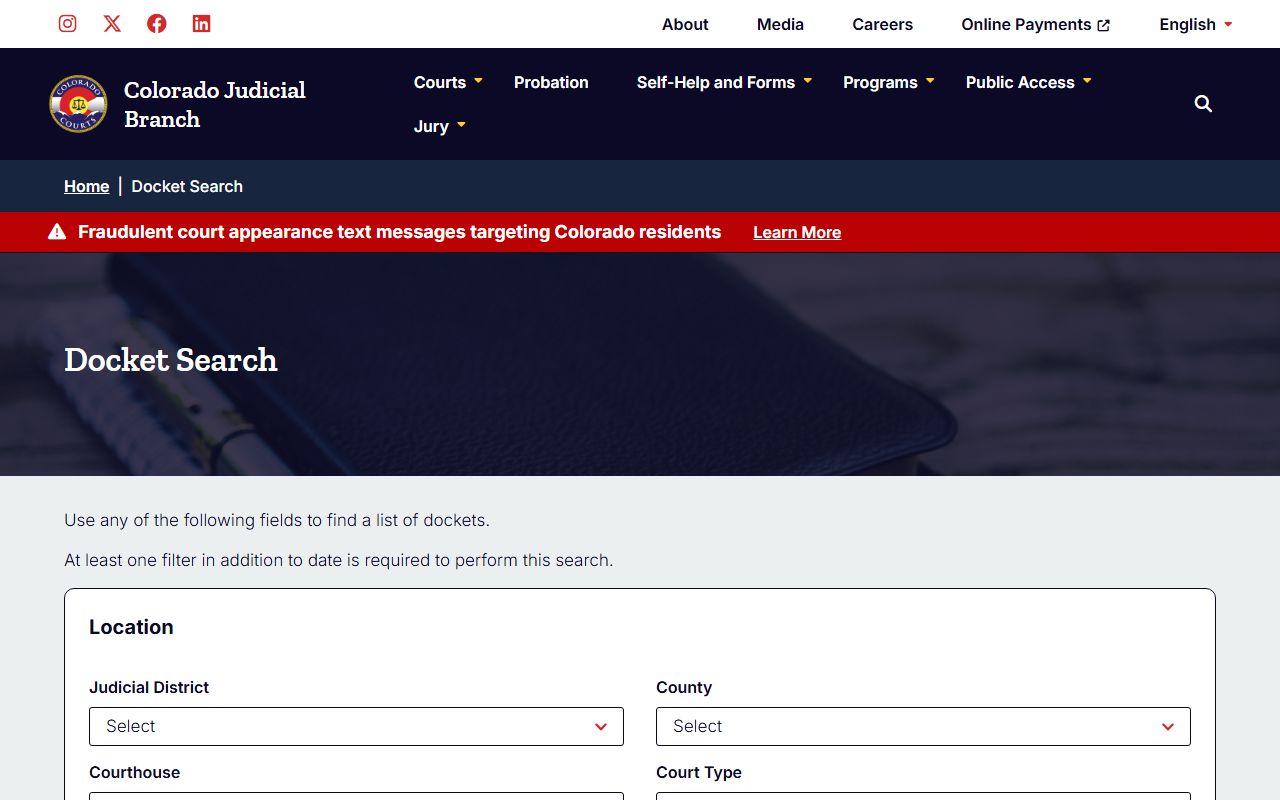
Use the docket result to follow the court case; use the Adams County Sheriff's Office records process for jail records, police reports, mugshots, or custody materials that the court does not supply.
How Charges Get Filed After an Arrest: Complaint, Information, and Indictment
A jail arrest does not decide the criminal case. Law enforcement books the person and submits reports for prosecutorial review. The 17th Judicial District Attorney then decides whether evidence supports filing criminal charges in Adams County court. The filed document may be a complaint, an information, or in less common serious matters, an indictment. From that point forward, the court record tracks the filed charge rather than simply repeating the booking label.
| Complaint | Information | Indictment | |
|---|---|---|---|
| Filed By | Usually a prosecutor, sometimes tied closely to officer-submitted allegations at the start of the case. | Prosecutor after reviewing reports, evidence, and probable cause. | Grand jury after considering evidence presented to it. |
| Common For | Initial criminal filings and many misdemeanor-level matters. | Many felony prosecutions and cases formally pursued by the DA. | Serious or complex felony matters; less common than prosecutor-filed charges. |
| Starts | The court case and charge list. | The court case and formal prosecution. | The court case based on grand-jury action. |
Charge Status in Court Records After Jail Arrest
Charge status changes as an Adams County case moves through court. Booking charges can differ from filed charges because the jail record reflects the arrest-side information available at intake, while the court record reflects the DA's charging decision and later court action. A filed charge may stay pending, be amended, be reduced to a lesser offense, be dismissed, or result in a disposition. Read the status count by count; one charge may be dismissed while another remains active or ends in conviction.
| Status | What It Means |
|---|---|
| Pending | The charge is still active and no final disposition has been entered for that count. |
| Filed | The prosecutor has formally initiated the charge in court after review of the arrest reports. |
| Amended / Reduced | The original charge was changed, corrected, or lowered as the prosecution moved forward. |
| Dismissed | The count ended without a conviction on that count. |
| Disposition | The court has entered a final result for the charge or case event. |
| Conviction | A finding or admission of guilt, usually through plea or verdict; it is not the same as an arrest. |
Bond and Release After an Adams County Arrest
Bond information can appear in jail records, court records, or both. The sheriff's roster or bond information page is a custody and release channel; the court docket tracks formal bond conditions, hearing dates, and orders. In Adams County, a judicial officer or court sets bond and release conditions based on the case, criminal history, public-safety concerns, appearance risk, statutory limits, warrants, and holds.
Use the Adams County Sheriff's Office bond information page for current jail procedure, and call the Adams County Detention Facility general information line at 303-654-1850 before going in person. Current payment methods and transactional hours were not captured in the research.
| Bond Type | How It Works |
|---|---|
| Cash Bond | Money is posted directly as ordered by the jail or court process. |
| Surety Bond | A licensed bail bonding agent posts an eligible bond for the defendant. |
| PR / Own Recognizance | The person is released on a promise to appear and comply with conditions; money may not be required up front. |
| Property Bond | Property secures release where allowed and ordered by the court. |
| No-Bond Hold | Ordinary bond release is not available until the hold, warrant, detainer, or court order is resolved. |
A hold for another agency, probation or parole, ICE, or federal custody can keep someone in jail even if a local Adams County bond is paid. Warrants may also carry a preset bond or require a court appearance before release is possible.
Warrants That Lead to an Arrest
The Adams County Sheriff's Office warrant search appears in the public records navigation and on the inmate search page. It uses first-name and last-name fields and displays important limits. ACSO states that warrant information excludes juveniles, is for reference only, is not confirmation that any warrant is active, and is not for use in legal action. Not finding a warrant does not prove no warrant exists; another agency may have issued it, or ACSO may not yet have entered it.
Warrants may be arrest warrants, bench warrants for failure to appear or failure to comply, fugitive or out-of-county warrants, or search warrants. Only some warrant types explain why a person was booked or held. ACSO notes that warrant records are updated daily by 7 AM. For information about a listed warrant, the Dispatch Center number in the research is 303-288-1535. For Warrants Section questions, the research lists 720-322-1325, Monday through Friday, 8:00 AM to 5:00 PM. ACSO also warns not to take action on your own.
Charges vs. Convictions in Adams County Court Records
An arrest and a filed charge are accusations, not proof that the person committed the offense. A conviction requires a plea, verdict, or other final court finding. A roster may show the arrest-side allegation while the court docket later shows amendment, dismissal, reduction, or conviction.
| Charge | Conviction | |
|---|---|---|
| Stage | Accusation filed or listed after arrest. | Final result by plea, verdict, or court finding. |
| Proof Level | Based on probable cause and prosecutorial filing decisions. | Requires proof beyond a reasonable doubt or an admission of guilt. |
| Record Meaning | Shows what was alleged and prosecuted. | Shows the person was legally found guilty of that count. |
| Can Change | May be amended, reduced, added, or dismissed. | May later be affected by appeal, post-conviction action, sealing, or other court order. |
Sealed vs. Expunged Arrest and Court Records
Colorado record sealing is a court process. A sheriff records request does not seal a court file, remove a criminal-history entry, or erase a docket. If a charge is dismissed or later becomes eligible, the person must follow the Colorado Judicial Branch self-help and court-record sealing process. Agencies and custodians may need the sealing order before changing public access to related records.
| Sealed | Expunged | |
|---|---|---|
| Visibility | Hidden from general public access by court order. | Destroyed or treated as though it did not exist where Colorado law allows. |
| Law Enforcement | May remain available to courts or criminal justice agencies in limited situations. | Access is more restricted and depends on the specific expungement law. |
| Common Use | Adult criminal cases, dismissed cases, or eligible dispositions under Colorado rules. | More limited categories, often juvenile or statute-specific records. |
| What to Do | Use Colorado Judicial Branch self-help and file through the court when eligible. | Confirm eligibility under Colorado law before assuming expungement applies. |
Court Records vs. Sheriff Records After an Arrest
Adams County court records and sheriff records answer different questions. Colorado Judicial dockets and Adams County court channels track formal charges, hearing dates, bond conditions, amendments, dispositions, and sentencing. The Adams County Sheriff's Office handles jail custody information, inmate search, warrants, mugshot requests, police reports, jail records, medical records, intake records, grievances, classification records, disciplinary records, secured-area video, photos, and custody letters through official records forms.
Colorado criminal justice records are governed by the Colorado Criminal Justice Records Act, CRS 24-72-301 and following. ACSO forms cite CRS 24-72-305.5 for restrictions on direct solicitation use, and the fee schedule cites CRS 24-72-306 for reasonable criminal justice record fees and page-copy charges. Court files use Judicial Branch access rules, Chief Justice Directives, and clerk processes.
Background Check Considerations
Casual docket review is not the same as a compliant background check. A court docket may show a pending case, dismissed charge, hearing date, or conviction, but it may not show statewide history, sealed material, non-Adams County cases, or every agency record connected to an arrest.
Important: This website is not a consumer reporting agency and cannot be used for FCRA-covered employment, tenant, credit, or insurance decisions.
Restricted Court Records After an Arrest in Adams County
Some Adams County court records after an arrest may be restricted from ordinary public access. Juvenile matters, sealed cases, expunged records, protected victim information, certain dismissed matters, and records tied to ongoing investigations may not appear in a public docket or may appear only in limited form. The ACSO warrant search also excludes juveniles and warns that its entries are reference-only.